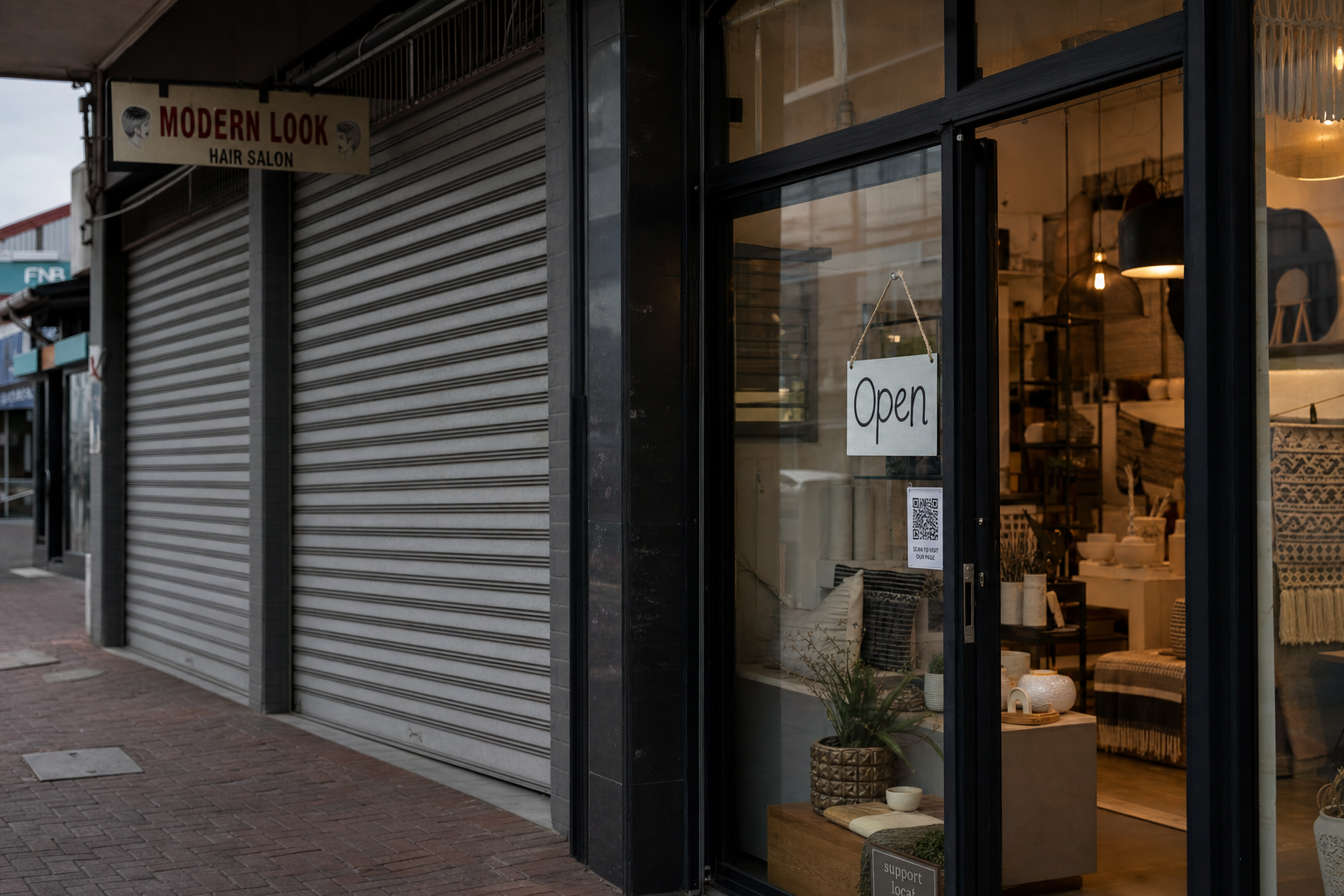
On a weekday in Durban’s inner city, one shopfront stays dark behind a rolled-down shutter while its neighbour keeps the lights on and a plain “Open” sign in the window. The contrast is ordinary—until you realise how many customers never make it that far. Reporting from Daily Maverick in late May 2026 describes more than a week of xenophobic violence, public assaults, and inflamed social-media mobilisation that left refugees and migrants camped outside government offices, too frightened to return to neighbourhoods where they had lived and worked for years.
For independent retailers—South African-born and migrant-owned alike—the damage is not only physical. It is commercial. When community tension dominates the news cycle, foot traffic thins across entire precincts, not just the businesses directly targeted. And when local directories and group chats fill with unverified claims about who is “open,” who is “legitimate,” and who should be avoided, the uncertainty itself becomes a tax on trade.
When headlines keep customers indoors
The current wave of anti-immigration demonstrations has swept through major cities including Durban, Johannesburg, and Pretoria, with violent and sometimes fatal results, according to Human Rights Watch. In Durban, a Cameroonian shop owner who has lived in South Africa for nearly 20 years told researchers he closed his shop, locked the doors, and turned off the lights during protests targeting foreign-owned businesses—only for a group to break down the door and assault him and colleagues with golf sticks, sjamboks, pepper spray, and stun guns. No law enforcement officers came to assist, he said.
That pattern ripples outward. TimesLIVE reported that anti-immigrant protesters shut down parts of the Durban CBD in early May, accosting shop owners and traders while law enforcement looked on. GroundUp spoke to displaced street vendors and roadside salon owners who said they could not return to work after attacks—regardless of whether they held valid papers. Junior Machiel, a refugee from the Democratic Republic of the Congo, said a group destroyed his city-centre salon structure and beat him with a sjambok. “They didn’t even ask us for our documentation,” he told the outlet.
Even customers with no connection to the conflict stay away. Diplomatic advisories reflect the wider chill: Ghana’s embassy advised nationals to shut shops and businesses in Durban ahead of planned protests, and the country later said it would evacuate citizens following what it described as a wave of xenophobic attacks (BBC). When fear spreads faster than facts, every trader on the block pays—in lost Saturday trade, cancelled appointments, and empty aisles.
Rumour travels faster than a verified listing
Social-media clips and forwarded voice notes have become part of how communities interpret local commerce during periods of tension. Daily Maverick quoted a Durban University of Technology lecturer describing an “aggressive social media drive” in which visuals are shared online and “the bigger the story gets, even when the story may not be intrinsically that big.” Workplaces were invaded and shut down, sometimes in the presence of police, in incidents filmed and shared on social media, the same report noted.
That dynamic turns business directories into battlegrounds. A listing with no verified contact number, outdated hours, or a generic WhatsApp link copied from a neighbourhood group chat gives rumour room to fill the gap. International relations department spokesperson Chrispin Phiri told TimesLIVE that officials were concerned about an increase in fake news around anti-immigration tensions. “We want people to act on actual facts,” he said. “Just because someone is a foreigner doesn’t mean they are a drug dealer and just because South Africans are protesting doesn’t mean they are violent and people are being hurt.”
Verification outcomes tell a different story from the loudest online narratives. After eThekwini officials arranged document checks for displaced people, Daily Maverick reported that Home Affairs checked the papers of 457 foreign nationals and found only two without proper documentation. GroundUp recorded a similar verification exercise in which community leaders said only one person in a large group was found to be in the country illegally. The gap between paperwork and public perception is precisely where unclear listings do the most harm: shoppers cannot tell from a blurry screenshot whether a salon, spaza, or repair shop is licensed, reachable, or simply closed for the day.
What fair directory standards require
Local commerce directories are not neutral background infrastructure—they shape who gets found, who gets called, and who gets avoided. During community tension, ethical listing standards matter as much as any shopfront sign.
At minimum, a responsible directory should publish accurate trading names, physical addresses or service areas, current opening hours, and contact channels the business itself controls—a dedicated business page, a contact form routed to the owner, and a verified badge where the platform offers confirmation. Listings should not republish personal mobile numbers scraped from protest footage, leaked group chats, or third-party data brokers without consent. South Africa’s Protection of Personal Information Act requires responsible parties to process personal information lawfully and to give data subjects meaningful control; the Information Regulator’s guidance on direct marketing under POPIA stresses that contact details must be obtained and used on legitimate grounds—not harvested for spectacle or intimidation.
Directories that allow anonymous “tips” about ownership or migration status without moderation become amplifiers for harassment. Platforms that remove outdated listings without notice strand customers at shuttered doors. The better practice is the boring one: confirm details with the business, timestamp the verification, display a clear badge, and route enquiries through official channels so owners are not forced to debate their right to trade in comment threads.
When citizen-led campaigns confront people in streets and shops, courts have drawn a bright line. A Gauteng High Court judgment cited by Daily Maverick held that only an immigration officer or a police officer may demand identity documents in public places, and that warrantless searches may not occur at home, school, work, or business. Directories are not immigration enforcement tools—and treating them as such erodes trust for every listed trader.
Independent retailers lose either way
South African-born independents suffer when entire precincts feel unsafe. Migrant-owned shops suffer when they are singled out. Both lose when customers choose to stay home rather than guess which listing is current.
Refugee spokesperson Bishop Raphael Bahebwe told Daily Maverick that displaced people were “hauled out of their homes and workplaces by armed vigilantes, slapped around, beaten and interrogated,” and that many could not go to work to support their families. Burundian refugee Jeanne Nahimana, in South Africa since 2003, described leaving her home and sleeping on a pavement without water. The Consortium for Refugees and Migrants in South Africa warned in a statement quoted by the same report that inflammatory rhetoric, misinformation, and unlawful mobilisation fuelled xenophobic tensions and risked more violence, displacement, and intimidation.
For Riverside traders and their counterparts in Durban, Hartbeespoort, and other high-street economies, the lesson is practical. Community tension suppresses foot traffic; unclear listings compound the loss by leaving shoppers nowhere reliable to turn. The remedy is not louder speculation—it is verified hours, confirmed contact paths, and business pages customers can trust before they leave the house.
When one shutter stays down, the whole row feels uncertain. Clear directories will not resolve deep social fractures on their own. But in a climate where fear campaigns move faster than foot traffic, they are one of the few tools commerce has to keep honest businesses visible—and reachable—without becoming part of the fight.
References
- Daily Maverick — Xenophobia crisis: Who is funding the June 30 fear-mongering?
- Daily Maverick — Police response under fire as anti-immigrant groups surge
- Human Rights Watch — South Africa: New Waves of Xenophobic Attacks
- GroundUp — Legally in SA but scared to go home: 150 immigrants camping at Durban Home Affairs
- TimesLIVE — SA on high alert, but beware of misinformation campaign on anti-immigration debate
- BBC — Ghana to evacuate 300 citizens from South Africa over anti-immigrant protests
- Information Regulator — Guidance Note on Direct Marketing under POPIA (PDF)