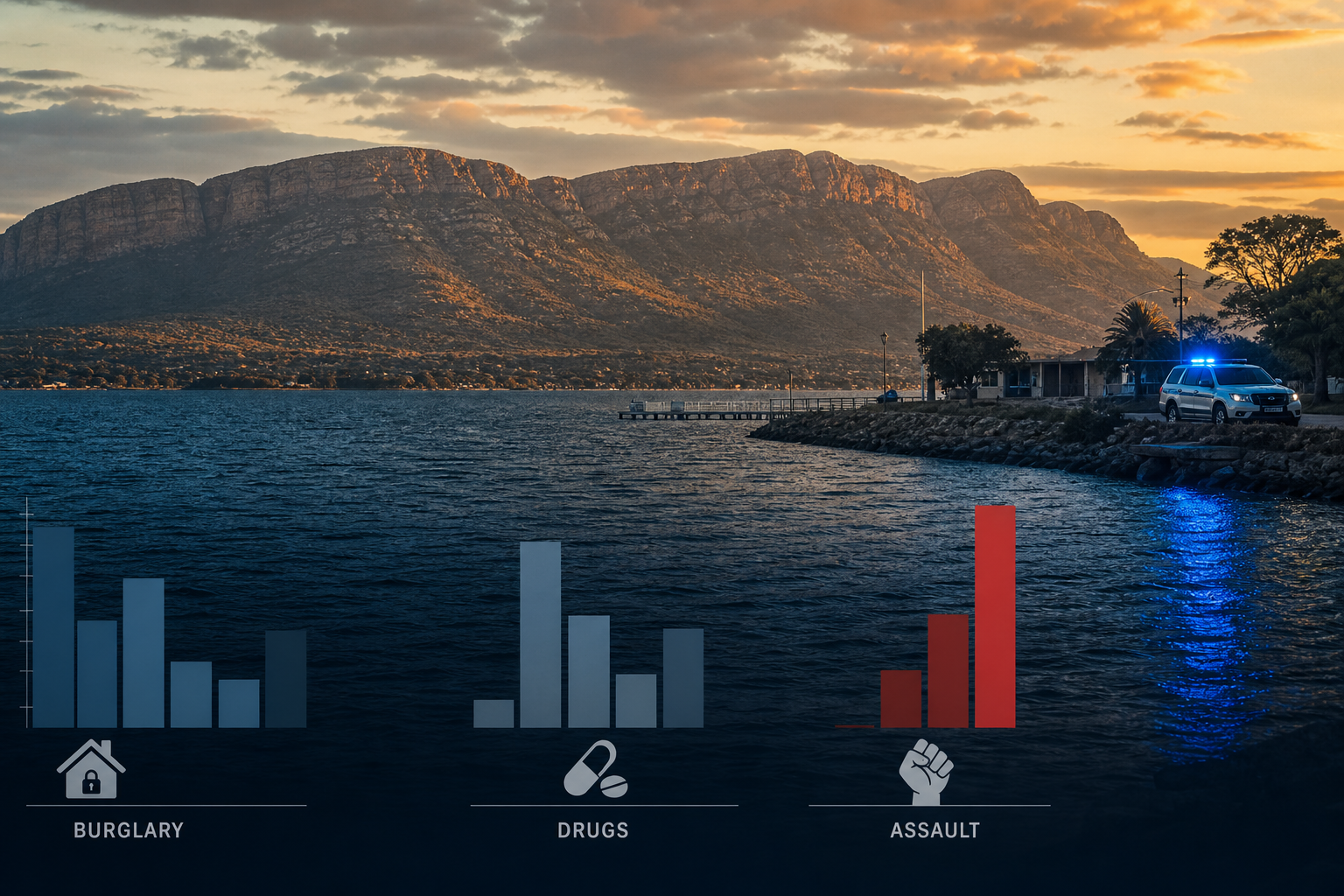
Hartbeespoort — the dam-side resort town in Madibeng, North West — sits inside the Hartbeespoortdam police precinct, a jurisdiction that covers Schoemansville, Ifafi, Kosmos, Meerhof, Melodie and surrounding areas. Because the South African Police Service (SAPS) publishes crime at precinct rather than suburb level, every community around the dam shares the same official statistics. What those numbers show, together with court records and policing operations reported since 2020, is a layered picture: property and petty offences remain a daily burden; drugs and alcohol sit at the centre of the precinct’s caseload; and murder, while less frequent than in South Africa’s worst hotspots, still punctuates life in the valley.
The national backdrop, 2020–2026
South Africa’s crime trajectory over the past six years cannot be read without the COVID-19 lockdown. In the financial year ending March 2020, SAPS recorded 21,325 murders nationally and 1,629,319 community-reported serious crimes (Minister Bheki Cele, 2019/20 annual release). The Institute for Security Studies noted that during the hard lockdown of April–June 2020, murder fell 35.8% and armed robbery 39.5% compared with the same quarter a year earlier — the steepest quarterly drops in 26 years — though analysts warned the relief would likely prove temporary as restrictions eased (ISS Africa).
The rebound was sharp. By 2022/23, national murder had climbed to 27,494 and community-reported serious crime to 1,586,508 (SAPS Annual Crime Report 2023/24). Drug-related offences detected through police action peaked at more than 323,000 in 2020/21 before fluctuating in later years; driving under the influence of alcohol or drugs also rose in several post-lockdown quarters. More recently, SAPS quarterly data for January–March 2025 showed murder down 12.4% year-on-year nationally, even as drug-related detections rose 15.2% (SAPS Q3 2024/25 report) — a mixed national picture that provincial and local figures echo in different ways.
In the North West, community safety MEC Wessels Morweng reported in March 2026 that community-reported crime fell 4.1% in the October–December 2025 quarter — the lowest festive-season total since 2022 — with 251 fewer murders than the same quarter a year before (TimesLIVE). Yet Bojanala Platinum, the district that includes Hartbeespoort, still accounted for 44.1% of reported crime in the province. Operationally, Brits and Hartbeespoortdam remain among stations provincial oversight committees flag for sustained attention (North West Community Safety).
Hartbeespoortdam by the numbers
According to SafeSuburb’s compilation of SAPS quarterly releases, the Hartbeespoortdam precinct recorded 1,322 serious crimes in the partial 2025/26 financial year (April–December 2025, nine months of data), up 7.8% compared with the same months of 2024/25. Despite that year-on-year rise, reported crime remained 2.2% below the precinct’s pre-COVID baseline (2018/19), suggesting a long recovery from the pandemic dip rather than an uninterrupted climb.
Raw counts place Hartbeespoortdam well above the North West provincial median for precincts of similar reporting volume — the area logged 156% more crimes than the provincial median in the latest period, though analysts caution that population size and tourism traffic affect totals and that SAPS figures reflect reported crime only.
The precinct’s leading offence categories in 2025/26 tell a story that runs from opportunistic property crime toward organised and lifestyle-linked harm:
| Category | 2025/26 (partial year) | Change vs same period prior year |
|---|---|---|
| Drug-related crime | 180 | +16 |
| Residential burglary | 174 | +1 |
| Common assault | 138 | +27 |
| Vehicle theft | 129 | +53 |
| Malicious damage | 104 | +32 |
| Murder | 8 | −6 |
Vehicle theft recorded the largest increase (+53 cases), while business burglary fell (−27). Murder declined from 14 to 8 in the comparable nine-month window — a modest improvement that nevertheless leaves families and employers in a tourism economy permanently alert to violent risk.
Petty and property crime: where prevention can bite
At the lower end of the seriousness scale, Hartbeespoort’s caseload mirrors national property-crime pressures. Residential burglary (174 cases), theft from motor vehicle (88), shoplifting (17) and business burglary (67) feature prominently in the latest SAPS breakdown. Nationally, residential burglary has remained stubbornly high — more than 163,000 cases in 2022/23 — while shoplifting climbed from 42,549 cases in 2021/22 to 53,117 in 2023/24 across South Africa (SAPS Annual Crime Report 2023/24).
North West province recorded 7,368 shoplifting cases over the four financial years from 2020/21 to 2023/24, according to a 2025 parliamentary reply from the Minister of Police. SAPS told legislators it cannot automatically break shoplifting down by stolen item type without manual docket review — a limitation that complicates targeting interventions such as food-security or school-supply theft — but the provincial totals underline that petty retail crime is a documented, recurring problem rather than anecdote.
Community surveys reinforce local unease. Numbeo’s crowd-sourced safety index for Hartebeespoort, last updated in February 2025, rated worries about home break-ins, car theft and vandalism in the “moderate to high” range, with 75% of respondents saying crime had increased over the past five years. Perception data is not a substitute for SAPS counts, but it aligns with the property-offence profile police report.
Crime researchers and policing strategists often argue that this tier of offending — shoplifting, minor theft, malicious damage, unlicensed liquor sales — is where education, visible compliance enforcement and community partnerships can still change behaviour before offenders graduate to armed robbery or organised syndicates. School-based prevention, business-watch schemes around the dam’s retail strips, and tighter municipal by-law enforcement on illegal trading have been advocated nationally; locally, arrests such as the 2024 seizure of an industrial-scale illegal distillery near Hekpoort — where Hawks seized machinery and stock valued at roughly R20 million — show how petty regulatory breaches can mask large illicit economies.
Drugs, alcohol and the lifestyle crime layer
Above property crime, drug-related offences have become the single largest category in the Hartbeespoortdam precinct — 180 cases in the latest partial year, up from 164 — overtaking residential burglary in raw counts. That pattern fits a wider provincial and national emphasis on substance-driven crime. North West’s third-quarter 2024/25 statistics release flagged stations such as Tlhabane, Mooinooi and Letlhabile among the province’s leaders in crimes detected through police action, a category that includes drug possession and drunken driving.
Policing operations around Hartbeespoort have repeatedly centred on narcotics. In February 2026, the provincial Operation Shanela 2 raided identified hotspots in Brits, Hartbeespoortdam, Hebron and Lethlabile, arresting six foreign nationals for possession of suspected crystal meth, khat and mandrax with an estimated street value of R31,600, including suspects arrested at the Hartbeespoortdam flea market. In May 2026, Operation Prosper netted 41 suspects in Skeerpoort and Schomburg for illegal mining and immigration violations, recovering firearms and mining equipment — a reminder that drug economies and illicit extraction often overlap in the Magaliesberg foothills.
Alcohol intersects directly with interpersonal violence. Hartbeespoortdam recorded 74 driving-under-the-influence cases in the partial 2025/26 year (+8). Academic work on heavy drinking and violence around alcohol outlets in North West has long linked tavern geography to assault risk — a dynamic that played out in grim fashion on New Year’s Eve 2024, when Lesego Klaas Makaku, 26, was accused of stealing a cellphone at a tavern in Sangiro informal settlement, beaten, and thrown into Hartbeespoort Dam. Five suspects were arrested; police leadership condemned licensed outlets that become “crime hotspots.”
Nationally, SAPS leadership has repeatedly tied tavern regulation to murder, assault and rape statistics. While Hartbeespoort is not Marikana — where a 2026 tavern mass shooting left seven dead — the provincial pattern of alcohol-fuelled violence frames local incidents as part of a broader North West challenge rather than isolated bar fights.
Murder, robbery and organised violence
Murder remains the gravest measure of public safety. Hartbeespoortdam’s eight murders in the nine months to December 2025 compare with 14 in the same window a year earlier, but individual cases show how quickly disputes escalate:
- In April 2021, three men appeared in court after security guard Samuel Maposa was bound, beaten and left in a ditch during a farm robbery near the dam; agricultural chemicals worth R30,000 were stolen.
- In 2024–25, detectives investigated a body found near Xanadu Estate after a robbery linked to a sex-work lure, with arrests extending to Atteridgeville in Gauteng.
- In February 2026, the Pretoria High Court convicted three farmers near Brits of the premeditated murder of farm dweller Dumisani Phakathi, beaten to death in September 2023 while collecting water from a furrow — a case prosecuted as murder, not a standalone hate-crime charge, but one that drew national attention to farm-area violence.
Aggravated robbery (87 cases, down 8), carjacking (20, up 11) and kidnapping (19, up 7) remain part of the contact-crime mix. Illegal mining adds another violent strand: a 2024 Vala Umgodi operation near Scheerpoort arrested 94 undocumented miners and seized generators and processing equipment worth millions, underscoring how organised illicit industry feeds arrest statistics far beyond traditional street robbery.
Race, identity and crime — both directions
Crime around Hartbeespoort is not reducible to race, but race and identity have surfaced repeatedly in criminal and quasi-criminal disputes — sometimes as motive, sometimes as context, and often as allegation awaiting final adjudication.
On the dam shoreline, a long-running struggle over state-owned land leases — many dating to apartheid-era 99-year grants — exploded into arson and protest. In 2024, community members marched under heavy police guard after two black-owned businesses were burned, alleging gatekeeping by established white traders. Water and Sanitation Deputy Minister David Mahlobo condemned the arson as criminality while acknowledging “issues of racial tensions we should not deny.” The South African Human Rights Commission found systemic racial discrimination in lease allocation; complainants and black business owners, in turn, argue that noise and environmental objections are applied selectively against black operators while white-owned venues host events without sanction — a dispute in which crimen injuria, arson, intimidation and administrative unfairness overlap.
In another direction, xenophobia and nationality feature in enforcement narratives rather than victim surveys. Operation Shanela arrests at the flea market involved foreign nationals; illegal-mining sweeps routinely include immigration charges. Nationally, Xenowatch documented 58 xenophobic discrimination incidents in 2020, rising to a peak of 110 in 2022, before dipping and rebounding (Xenowatch overview 2022–24) — a reminder that hostility toward outsiders is tracked separately from SAPS precinct tables and remains unevenly distributed across provinces.
South Africa’s Prevention and Combating of Hate Crimes and Hate Speech Act (2023) now requires authorities to gather hate-crime data, but most Hartbeespoort cases cited in public reporting are prosecuted under murder, arson, assault or robbery statutes unless prosecutors add hate-crime aggravation. Numbeo respondents in Hartebeespoort rated worry about physical attack “because of your skin colour, ethnic origin, gender or religion” at 75/100 — high, but reflective of perception rather than verified hate-crime counts.
Farm and township violence, lease wars, and tavern assaults therefore cut across racial and ethnic lines in different ways: black business owners alleging exclusionary arson; white and black residents trading accusations over noise and land access; farm employers convicted of killing a black farm dweller; foreign nationals arrested in drug and mining raids. Understanding Hartbeespoort’s safety challenge means holding those threads together without treating any single narrative as the whole story.
Policing response and what the trend lines suggest
Law enforcement has responded with rotating national and provincial operations — Shanela, Prosper, Vala Umgodi — that produce arrest spikes in drug, immigration and illegal-mining categories precisely when those operations run. That can distort year-on-year comparisons: a precinct’s drug tally may rise because policing intensified, not only because use increased.
Taken together, the 2020–2026 record suggests Hartbeespoortdam remains a high-volume precinct within North West, with crime still slightly below its pre-COVID total but trending upward in the most recent nine-month window. Property crime and assault dominate daily reporting; drugs and alcohol anchor the lifestyle-offence layer; murder and organised illicit activity sit at the apex, episodic but devastating.
For residents, tourists and businesses around the dam, the statistical story is not one of uniform decline or uniform crisis — it is a stack of risks in which prevention at the petty end, treatment and compliance at the substance layer, and sustained detective work on murder and syndicates each address a different slice of the same SAPS ledger. National policy debates on taverns, hate-crime recording and illegal mining will continue to shape local outcomes long after the next quarterly release adds another row to the Hartbeespoortdam count.
References
- Hartbeespoortdam SAPS Crime Data — SafeSuburb
- SAPS Annual Crime Report 2023/2024 (PDF)
- SAPS Third Quarter Crime Statistics 2024/2025 (PDF)
- SA crime reductions during COVID-19 lockdown may be short lived — ISS Africa
- Minister Bheki Cele: Annual Crime Statistics 2019/2020 — South African Government
- CRIME STATS | North West festive season drops to lowest since 2022 — TimesLIVE
- North West 3rd Quarter Crime Stats — Department of Community Safety and Transport Management
- Question to the Minister of Police NW3350 (shoplifting by province) — PMG
- Crime in Hartebeespoort — Numbeo
- Man accused of stealing a cellphone dumped in Hartbeespoort Dam — The Citizen
- No bru: Manager of Hartbeespoort's illegal distillery appears in court — The Citizen
- Operation Shanela 2 in Brits and Hartbeespoortdam — Traffic Information
- Operation Prosper nets 41 suspects in illegal mining crackdown in Hartbeespoort — Naledi News
- Huge zama zama operation brought down near Hartbeespoort Dam — The Citizen
- Three in court for murder of Hartbeespoort farm security guard — TimesLIVE
- Suspects to appear in court for Hartbeespoort Dam murder, robbery — SABC News
- Three men convicted of premeditated murder of North West farm worker — News24
- Community members march in Hartbeespoort Dam to address racial tensions — The Citizen
- Water department takes action as racial tension continues at Hartbeespoort Dam — News24
- Race, regulation and resistance collide at Hartbeespoort Dam — The Citizen
- Heavy drinking and interpersonal violence at alcohol outlets in North West — Social Work/Maatskaplike Werk
- Xenophobic Discrimination in South Africa: Trends 2022–2024 (PDF) — Xenowatch
- Prevention and Combating of Hate Crimes and Hate Speech Act 16 of 2023 (PDF) — Government of South Africa
- Bloodbath at Marikana tavern leaves seven dead — Daily Sun