At midnight on 15 May 2026, Eskom completed a full year without implementing load-shedding—the first such stretch since September 2018 (Eskom — grid stability, May 2026). For many small businesses, that milestone is more than a statistic. It means fridges that stay cold through a service, ovens that finish a batch, and staff rosters that no longer pivot around published stage schedules.
The national picture has shifted sharply from the crisis years. Eskom recorded 205 days of load-shedding in 2022 and 335 in 2023; its winter outlook for 2026 projects no rotational cuts through August, citing improved plant performance under its Generation Recovery Plan (African Business — post load-shedding stability; Eskom — grid stability, May 2026). Chief executive Dan Marokane said Eskom now offers “a stable electricity platform to operate and grow from” (African Business — post load-shedding stability).
Reliability, however, is not the same as affordability—and the bill arrived on schedule.
Tariffs rise even as the grid holds
On 1 April 2026, Eskom direct customers began paying an average tariff increase of 8.76%, following a National Energy Regulator of South Africa (NERSA) decision on 5 March (Eskom — NERSA FY2027 tariffs). Municipal bulk purchasers will implement increases averaging 9.01% from 1 July, in line with the municipal financial year (Eskom — NERSA FY2027 tariffs; Eskom — 2026/2027 tariff schedule).
The hike is higher than the 5.36% initially set under the multiyear price determination after NERSA corrected a R54.7-billion error in its calculation of Eskom’s regulatory asset base; regulators said part of that amount would be recovered over three financial years, starting with R12-billion in 2026/27 (Engineering News — NERSA tariff approval). Structural changes also shift more cost into fixed charges: the Generation Capacity Charge rose to 30% of its originally proposed value, up from 20%, while residential service fees on Homepower and Homeflex tariffs now recover a larger fixed share (Eskom — 2026/2027 tariff schedule).
For a neighbourhood café running a display fridge, a salon’s heated tools, or a maker’s workshop equipment, the arithmetic is straightforward. The same rand buys fewer kilowatt-hours than it did in March—and for many prepaid households, that erosion is felt at the meter before it appears in a formal invoice.
Eskom’s group chief financial officer Calib Cassim acknowledged affordability pressures while arguing the increase supports maintenance and investment in a reliable system (Eskom — NERSA FY2027 tariffs). The Energy Intensive Users Group, representing heavy industry, has described continual price rises as factors behind plant closures and weak investment (African Business — post load-shedding stability).
Local outages, industrial pressure—and bills that keep climbing
Nationwide load-shedding may have paused, but localised disruption has not disappeared. Illegal connections, cable theft, and vandalism still trigger unplanned outages—sometimes lasting days—in dense communities where transformers overload (African Business — post load-shedding stability). Eskom reported that “non-technical losses” from theft and illegal use reached 8% of supply in the last financial year, costing roughly R17.5-billion in lost revenue (African Business — post load-shedding stability).
Unlike scheduled load-shedding, these cuts arrive without warning. Analysts note that unpredictability can be harder to manage than a published timetable: a cold chain cannot be replanned mid-service, and security or point-of-sale systems may fail without notice (African Business — post load-shedding stability).
At industrial scale, high grid tariffs continue to squeeze energy-intensive sectors. Ferroalloy smelters have closed or scaled back as electricity costs outpace global competitors, even as Eskom negotiates targeted relief for some producers (African Business — post load-shedding stability). That pressure ripples outward through supply chains and local employment—another reason household and small-business budgets feel tight even when headline inflation looks contained elsewhere in the economy.
What independent traders should put on the record
The operational lesson of the past five years has not vanished with the last stage announcement. Backup power—inverter-battery setups, generators, or hybrid arrangements—remains part of the cost base for traders who cannot afford to lose a cold room or a day’s bookings. Diesel prices have also climbed amid global fuel volatility, raising the running cost of generator backup for firms that still rely on it (African Business — post load-shedding stability; Moneyweb — April 2026 tariff hike).
What has changed is planning horizon. With rotational cuts off the calendar for now, businesses can schedule production, opening hours, and staffing with greater confidence (Eskom — 365 days without load-shedding). The conversation on the shop floor, however, has moved from “which stage are we on?” to “what did the April tariff do to our margin?”
Editors and customers alike benefit when that shift is reflected clearly online—not only in a WhatsApp status line that half the contact list never sees. Cafés, salons, cold-chain operators, and small manufacturers should treat their websites as the authoritative record for:
- Trading hours and service windows, including any reduced days while costs are reviewed
- What is in stock or available to order, especially for perishable or made-to-order lines
- Delivery, collection, and booking policies, if surcharges or minimum orders change
- Any electricity-related surcharge or price adjustment, stated plainly rather than discovered at checkout
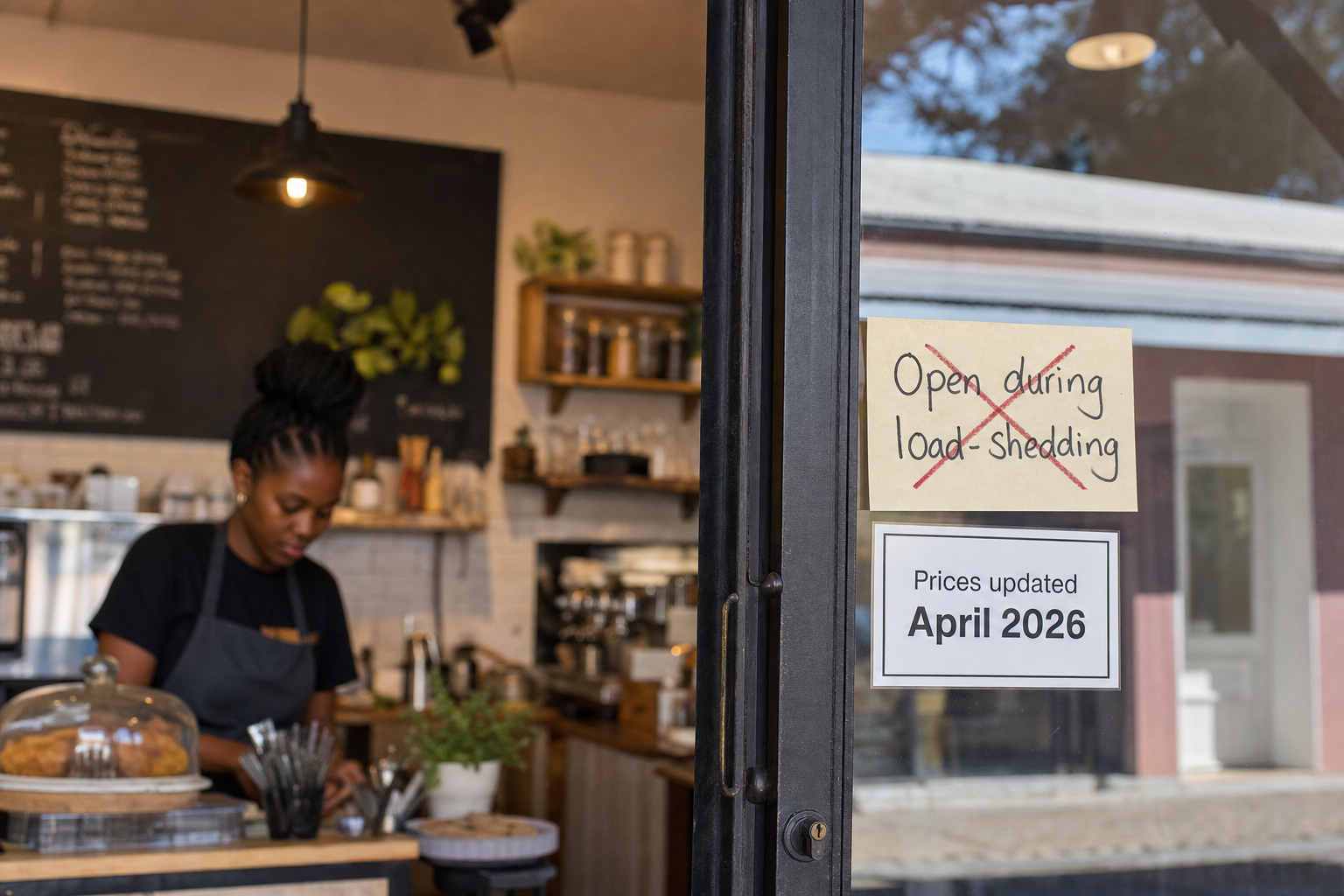
A crossed-out “Open during load-shedding” sticker on the door tells one story. A visible “Prices updated April 2026” note—mirrored on the business website—tells the current one.
Reliability worth celebrating, costs worth naming
South Africa’s power system has earned a genuine respite. Unplanned outages on Eskom’s fleet fell by more than 5 GW year on year in mid-May, and open-cycle gas turbine use dropped sharply as coal performance improved (Eskom — system performance, May 2026). That is real progress for an economy that lost billions to interrupted shifts and spoiled stock.
Progress on supply does not cancel the tariff line on the municipal account. Until price paths ease—or incomes catch up—independent traders will keep balancing reliability gains against bills that still rise. Naming both honestly, on the door and on the web, is how customers plan—and how businesses keep trust when the lights stay on but cost more than they used to.
References
- A year after load-shedding, South Africa fights electricity theft — African Business
- Eskom maintains grid stability as winter demand rises — Eskom
- Eskom delivers 365 days without load-shedding — Eskom
- Eskom implements NERSA decision for Financial Year 2027 — Eskom
- 2026/2027 Tariff Increase — Eskom Distribution
- Eskom maintains strong system performance — Eskom
- Nersa approves higher electricity hikes for 2026/27 — Engineering News
- Eskom’s 8.8% tariff hike kicks in on 1 April — Moneyweb